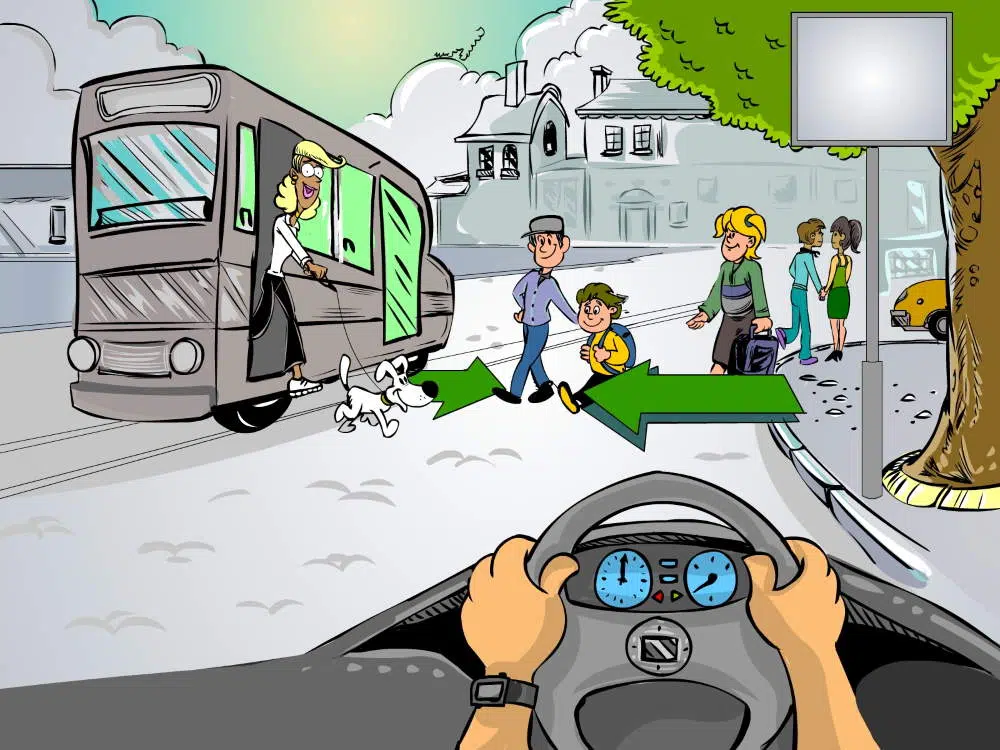
In Swiss cities, trams always have priority – from the right and from the left. Overtake only on the right, stop at unmarked tram stops to let passengers board / alight.
Trams Always Have Priority
Trams have priority over all other vehicles – from the right and from the left – unless a sign or signal says otherwise (Art. 38 RTA).
The tram has priority on its own track – except when it joins a main road from a minor road. It is therefore one of the special right-of-way cases that override priority from the right.
Reason: a tram cannot swerve and its braking distance is much longer than a car’s.
At stops without a safety island, vehicles must wait until passengers have cleared the road
Passing a Tram
Overtake only on the right – never on the left (the tram tracks are usually in the middle)
If a tram is at a stop without a refuge island, you must stop until passengers have boarded / alighted
Tram tracks must be free – do not stop on or beside the tracks where you would obstruct the tram
Tracks, Curves and Signals
When crossing tram tracks, do so at a flat angle to avoid the wheels slipping – especially on wet rails.
A tram in a curve overhangs the rails by up to 1 m on each side – keep a clear safety distance.
Tram drivers use a three-light signal (yellow arrows): straight, left or right – do not confuse it with car traffic lights.
Bus and tram stops
At stops you must expect pedestrians crossing in front of and behind the vehicle – often without looking.
A bus pulling out: within built-up areas you must give way as soon as it signals. Brake if necessary.
Passengers alighting: at a stop without an island you may only pass at walking pace – or you must stop.
Trams: they have priority, including when coming from the left.
Practise now
Practise with official exam questions
Over 800 official questions of the Swiss driving theory exam.